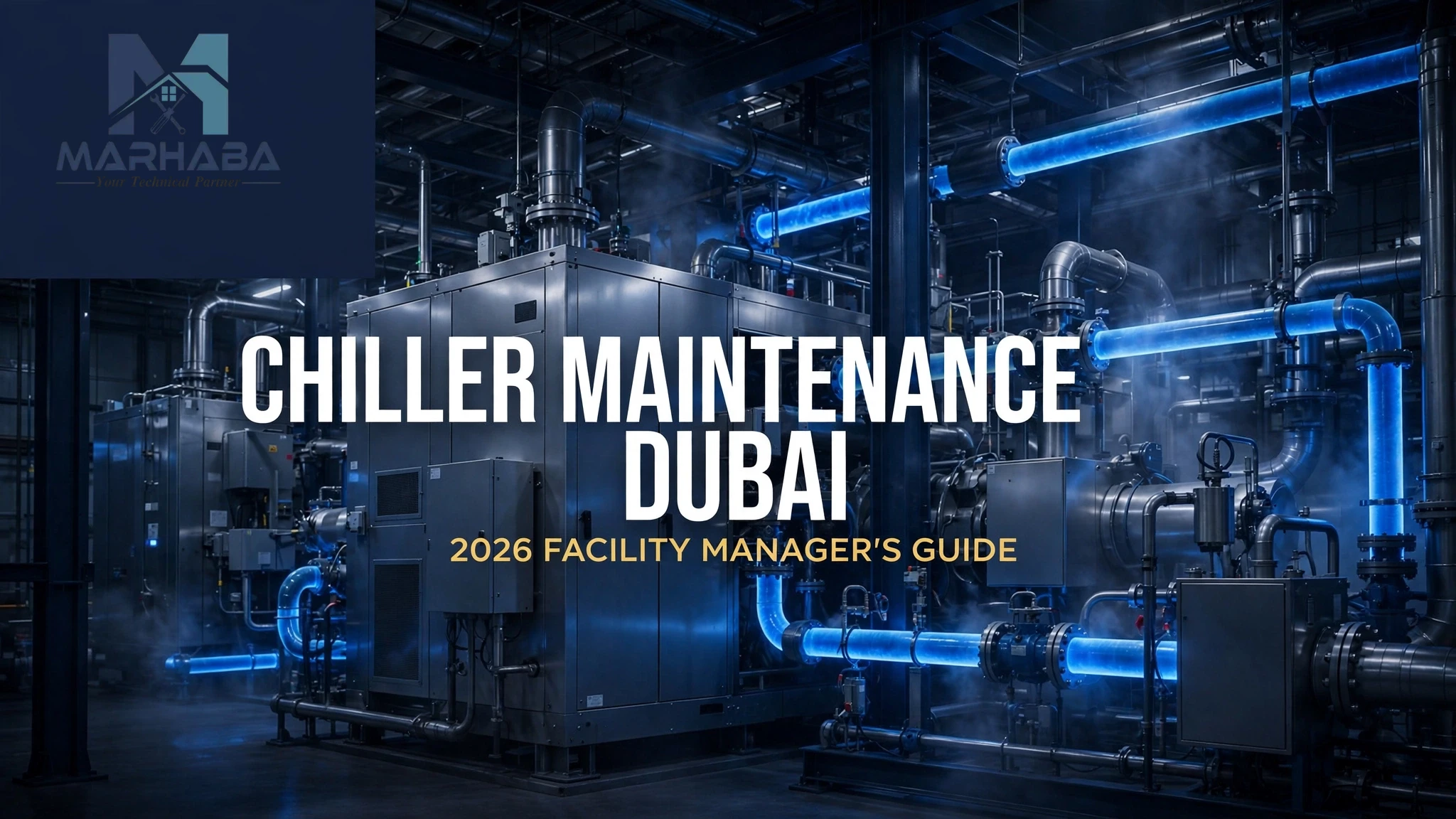

Chiller Maintenance Dubai (2026): Commercial & Facility Manager Guide
42
Chiller Maintenance in Dubai (2026): The Facility Manager’s Guide
Quick answer: Chiller maintenance in Dubai means scheduled servicing of the commercial cooling plant — monthly log reviews, quarterly inspections, semi-annual cooling-tower work and an annual deep service. For most commercial buildings it runs on an annual maintenance contract (AMC), and water-cooled plants need more scope than air-cooled ones. Done properly, it prevents the single most expensive failure a facility manager in Dubai can face: a chiller breakdown in peak summer.
Here’s the thing most people outside facilities management don’t realize: in Dubai, chiller maintenance is not a maintenance task. It is a business decision. Cooling is the single largest line in a commercial building’s energy bill, and when a chiller fails in August, it is not an inconvenience — it is a business continuity event. Hotel lobbies empty out. Mall footfall drops. Tenants start calling, then complaining, then withholding. This guide is written for the people who carry that responsibility: facility managers, building owners and operations heads across Dubai. It covers what a proper chiller maintenance plan includes, what drives AMC pricing, how air-cooled and water-cooled systems differ, the compliance items Dubai Municipality expects, and how to pick a contractor you won’t regret.
Why Dubai Punishes Neglected Chillers
Dubai’s chillers work harder than almost anywhere else on earth. Nine months of cooling season, fine desert dust that loads filters and coils in weeks, and near-continuous operation all accelerate wear. We see the same pattern every year: a plant that skipped its spring servicing limps into July, energy consumption creeps up as fouled coils force compressors to work harder, and then something gives at 2 pm on the hottest week of the year.
The economics are brutally simple. A planned maintenance visit costs a fraction of an emergency compressor replacement. And both cost a fraction of what a hotel or shopping mall loses during a few hours without cooling. That’s why serious operators don’t call contractors when things break — they put the plant on an annual maintenance contract (AMC) with a defined emergency response time. If AMCs are new to you, our AC AMC Dubai guide explains exactly what a well-written contract should contain.
What a Chiller Actually Is (and the Types You’ll Find in Dubai)
A chiller is a machine that removes heat from water (or air) and rejects it elsewhere, producing the chilled water that circulates through a building’s air-handling units and fan coil units. If your building has a plant room with big steel boxes and insulated blue piping, you have chillers.
The four compressor types you’ll encounter in Dubai’s commercial buildings:
- Centrifugal chillers — the workhorses of large towers, malls and district cooling plants. High capacity, high efficiency, and the most expensive to repair when they fail.
- Screw chillers — common in mid-size commercial buildings and hotels. Robust, widely serviced, good part-load performance.
- Scroll chillers — smaller commercial and light industrial applications. Simpler, modular, easier to service.
- Reciprocating chillers — older installations and some industrial sites. Reliable but less efficient; many are being phased out.
Your maintenance scope depends on which type you have — a centrifugal plant’s annual deep service (oil analysis, eddy current tube testing) is a different job from a scroll chiller’s routine servicing. Any contractor quoting your AMC should know your compressor type before naming a price. If they don’t ask, that’s your first red flag.
The Maintenance Schedule That Actually Works in Dubai
Forget the generic manufacturer schedule printed for temperate climates. In Dubai, dust, runtime hours and ambient temperatures demand a tiered rhythm. This is what a proper commercial chiller maintenance plan looks like:
| Frequency | What gets done | Why it matters |
|---|---|---|
| Monthly | Chiller plant log review (chilled water temps, pressures, compressor amps vs baseline); BMS alarm review; plant room visual inspection for leaks, noise, vibration; AHU/FCU filter checks by condition | Catches drift before it becomes failure; Dubai dust makes fixed filter schedules unreliable |
| Quarterly | Refrigerant level and pressure checks; condenser coil inspection and cleaning; cooling tower basin and drift eliminator inspection; belt tension and bearing checks on AHU fans | Fouled coils are the #1 cause of creeping energy bills; refrigerant leaks caught early are cheap |
| Semi-annual | Full AHU coil cleaning; accessible ductwork inspection; cooling tower chemical dosing review; Legionella risk assessment documentation; controls and thermostat calibration | Dubai Municipality requires Legionella documentation for commercial cooling towers |
| Annual | Full chiller deep service: oil acidity test, eddy current testing of condenser/evaporator tubes, refrigerant leak detection; full system performance evaluation vs previous year | The one visit that predicts next year’s failures — skip it and you’re flying blind |
As a rule of thumb: commercial chillers need professional inspection every 3 to 6 months — minimum twice a year, quarterly for heavy-use systems like hotels, hospitals and malls. The annual deep service is non-negotiable; oil acidity and tube condition tell you what’s coming twelve months before it happens.
Air-Cooled vs Water-Cooled: Why Your AMC Price Depends on It
Dubai has both, and they are different maintenance jobs. This is the single most common reason AMC quotes vary wildly — contractors are pricing different scopes.
Air-cooled chillers reject heat directly to outdoor air. They’re typically 10–15% cheaper to buy, install much faster (no cooling tower, no condenser-water pumps, no extensive piping to commission), and they’re simpler to maintain: no water systems means no scaling, no corrosion in condenser water, no water treatment programme, no Legionella documentation. They suit rooftops and sites where water infrastructure is limited or expensive.
Water-cooled chillers reject heat through cooling towers and condenser water. For a building running cooling around the clock — a tower, a hotel, a hospital — they’re meaningfully more efficient over their lifetime, which matters enormously given Dubai’s electricity tariffs and nine-month cooling season. But they demand more maintenance: tower upkeep, chemical dosing, drift eliminator inspection, water treatment management, and the Legionella risk assessment documentation that Dubai Municipality requires for commercial properties with cooling towers.
The practical takeaway: if a contractor quotes the same AMC price for an air-cooled and a water-cooled plant of the same tonnage, they haven’t understood the job. The water-cooled system carries materially more maintenance work, and the quote should reflect it.
What Drives Chiller AMC Pricing in Dubai
You’ll never find a standard published rate card for chiller AMCs, because the variables are too wide. When you collect quotes — get at least three — these are the levers that move the price:
- Capacity in tons of refrigeration. Always quote by tonnage, never by “one chiller.” A 500-ton centrifugal plant is a different universe from a 60-ton scroll package in labor hours, refrigerant handling and parts exposure.
- System type. Water-cooled with cooling towers costs more to maintain than air-cooled, as explained above.
- Age and condition. Older plants need more corrective work. Reputable contractors audit the plant before committing to a comprehensive AMC and price the existing backlog separately — be suspicious of anyone who doesn’t.
- Scope: labor-only vs comprehensive. Labor-only covers servicing; comprehensive includes parts and consumables. Compare like with like. A cheap comprehensive quote that excludes “major parts” without defining them is the oldest trick in the book.
- Response-time SLA. Four-hour emergency response for a hotel costs more than next-business-day for an office block — and it’s worth every dirham when the plant trips at 2 pm in July.
- Compliance documentation. Service logs, Legionella assessments, energy reports for auditors and insurers — professional hours, but also what keeps you compliant and defensible.
Insist on a site survey before signing anything. The survey is where a good contractor earns the contract: they’ll log your tonnage, compressor types, tower condition and control setup, then scope the AMC to reality instead of a template.
Dubai Compliance: The Items That Catch People Out
- Legionella control. Commercial properties with cooling towers must maintain chemical dosing programmes and Legionella risk assessment documentation per Dubai Municipality requirements. Your contractor should produce this as part of the AMC — if it’s not in the scope, you’re exposed.
- Refrigerant management. Leak detection and proper refrigerant handling belong in the annual deep service. It’s an efficiency issue, an environmental issue, and increasingly a documented one.
- Service records. Keep every service report. Insurers, auditors and building owners ask for them, and they’re your evidence if a breakdown turns into a dispute about who maintained what.
Choosing a Chiller Maintenance Contractor in Dubai
Here’s an uncomfortable truth: the company that services your split ACs well is not automatically qualified for a 500-ton centrifugal plant. Chillers are specialist equipment, and the contractor pool is thinner than the general AC market. Look for:
- Multi-brand capability. Technicians experienced across the major chiller brands — Carrier, Trane, York, Daikin, McQuay, Mitsubishi, LG — not a single-brand shop guessing at the rest.
- A site audit before quoting. Non-negotiable. No survey, no signature.
- Written service reports after every visit. Readings, findings, recommendations — not “serviced OK” on a carbon copy.
- Contractual emergency response. 24/7 call-out with a response time in writing. Ask the direct question: “My chiller trips on a Friday night in July — what exactly happens?” The quality of that answer tells you everything. And if it does happen, our emergency AC repair guide covers the critical first hour.
- References from comparable buildings. Hotels, towers, malls with similar plants. Call them and ask about response times, not just price.
- Whole-system accountability. Prefer one contractor for the full chilled-water system — chillers, towers, pumps, AHUs, FCUs and ductwork. It kills the blame game when comfort complaints start. See our AC maintenance Dubai and AC repair Dubai pages for the full scope.
Red flags that should end the conversation
- A quote with no site visit.
- Annual scope with no mention of oil analysis, eddy current testing or leak detection.
- No contractual emergency response time.
- “Comprehensive” AMCs that exclude major parts without defining what “major” means.
- No sample service report to show you. If they can’t show you what good reporting looks like, they don’t do it.
Frequently Asked Questions
How often should a commercial chiller be serviced in Dubai?
Minimum twice a year, with quarterly inspections for heavy-use systems (hotels, malls, hospitals). Monthly operational log reviews should run year-round regardless.
What is included in a chiller AMC in Dubai?
Scheduled preventive visits from monthly checks through the annual deep service, corrective call-outs, emergency response within a contracted time, a written report after every visit, and — in comprehensive contracts — spare parts and consumables. Read the exclusions as carefully as the inclusions.
How much does chiller maintenance cost in Dubai?
It depends on tonnage, system type (water-cooled costs more to maintain than air-cooled), plant age and condition, whether parts are included, and the response-time SLA. Get at least three quotes after a site survey, and compare scope line by line — the cheapest quote with the thinnest scope is the most expensive contract you’ll ever sign.
Air-cooled or water-cooled chiller — which suits Dubai better?
For large buildings with round-the-clock cooling, water-cooled systems are more efficient long-term but need more maintenance (towers, water treatment, Legionella documentation). Air-cooled chillers cost less upfront, install faster and are simpler to look after. The right answer depends on building size, water availability and operating hours.
What are the signs my chiller needs servicing?
Rising energy bills for the same cooling output, longer compressor run times, unusual noise or vibration, repeated BMS alarms, and refrigerant top-ups between services. By the time a chiller trips on fault, the maintenance was already overdue.
What is eddy current testing and why does my annual service include it?
It’s a non-destructive test of the chiller’s condenser and evaporator tubes that finds thinning, pitting and fouling before tubes fail. A tube failure means water in the refrigerant circuit — one of the most expensive chiller repairs there is. The test is cheap insurance.
Do I need Legionella documentation for my cooling towers?
If your building is commercial and has cooling towers, yes — Dubai Municipality requires maintained chemical dosing programmes and Legionella risk assessment documentation. Your maintenance contractor should handle this within the AMC scope.
Can one contractor handle chillers, AHUs and ductwork together?
Yes, and they should. A single accountable contractor for the whole chilled-water system — plant, towers, pumps, air handling and distribution — means one throat to choke when something goes wrong, and no finger-pointing between vendors.
Book a Chiller Plant Survey
If your building runs on chillers, the cheapest time to close a maintenance gap is before the next breakdown — not during it. Marhaba Technical surveys commercial chiller plants across Dubai, scopes AMCs around your tonnage, compressor types and operating hours, and backs them with contractual emergency response.
WhatsApp us on +971 58 157 7207 to book your plant survey.
One half of the chiller’s job happens up at the tower. Our cooling tower maintenance guide covers the water treatment, cleaning cycles and Legionella control programme that keeps condenser water temperatures — and energy bills — where they should be.