
Emergency AC Repair Dubai: What to Do Before the Technician Arrives (2026 Guide)
46
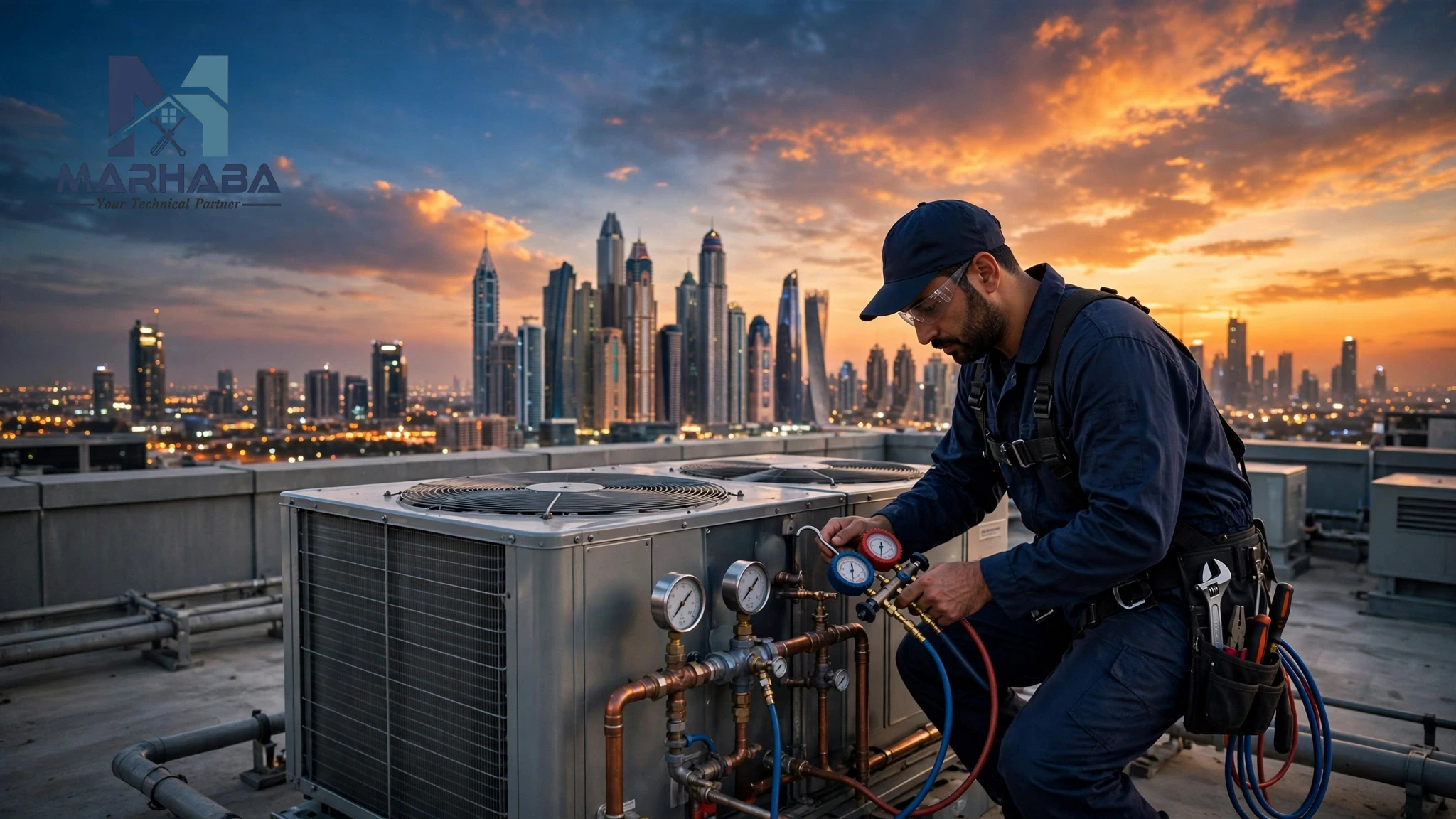
When the cooling dies in a Dubai building at 2 PM in August, the clock starts ticking fast. Offices overheat within the hour, hotel guests complain within minutes, and retail footfall walks out the door. This guide to emergency AC repair in Dubai covers exactly what to do in those first critical minutes before the technician arrives — and how to judge whether your service provider’s emergency response is actually good enough for a commercial building.
What Counts as an AC Emergency in a Commercial Building?
Not every AC fault needs a 2 AM call-out. In a commercial setting — offices, hotels, retail, restaurants, warehouses — these qualify as genuine emergencies:
- Total cooling failure in occupied areas during business hours or guest hours
- Burning smells or smoke from any unit — switch off immediately and treat as an electrical hazard
- Water pouring from ceiling units or AHUs — ceiling damage and slip risk escalate fast
- Repeated breaker trips — a sign of compressor or electrical faults that can become fire risks
- Loud grinding or banging noises followed by shutdown — mechanical failure in progress
A slightly noisy fan, a single warm room, or weak airflow in one zone can usually wait until the next working visit — but call your contractor and log it. In our experience, roughly two-thirds of genuine AC breakdowns in Dubai commercial buildings showed warning signs weeks earlier that a scheduled service would have caught. That’s what our AC maintenance in Dubai program is built around: catching faults before they become emergencies.
What to Do in the First 10 Minutes
These steps protect people, property, and the equipment itself while the technician is on the way:
- Switch the unit off at the breaker if you smell burning, hear grinding, or see water ingress. Never force a faulted unit back on — it turns a repairable fault into a compressor replacement.
- Clear the area. Move stock, electronics, and documents away from leaking units. In kitchens, shut down heat-producing equipment in the affected zone.
- Ventilate where safe. Open doors and windows in offices; in hotels, inform the front desk so they can manage guest rooms proactively rather than react to complaints.
- Check the basics. Tripped breaker, blocked outdoor unit, thermostat accidentally switched — a quick check rules out the simple causes. But don’t open panels or touch refrigerant lines; that’s technician territory.
- Call with details ready. Unit type (split, cassette, AHU, chiller-fed FCU), location in the building, brand if visible, and exactly what happened. A good 24/7 AC repair Dubai dispatcher uses this to send the right technician with the right parts.
Protecting Tenants, Guests, and Operations
In residential buildings the discomfort is obvious. In commercial buildings the damage is financial. A hotel losing cooling in the lobby at check-in time loses reviews before it loses sleep. A restaurant with a failed kitchen extract and no cooling loses the service. An office tower at 30°C interior sends staff home — and sends the FM team the bill for lost productivity.
This is why the response-time question matters more than the call-out fee for commercial clients. Ask your contractor: what is the guaranteed emergency response time under contract, and what happens if you miss it? Under a proper AMC, emergency response is an SLA line item — typically 2–4 hours for commercial sites — not a vague promise. See our guide to what’s included in an AC AMC in Dubai to know exactly what should be written into yours.
Common Emergency Faults and What They Mean
| Symptom | Likely cause | Urgency |
|---|---|---|
| No cooling, unit running | Refrigerant leak, failed capacitor, blocked coil | High — compressor damage risk |
| Burning smell | Overheating motor, wiring fault, PCB failure | Critical — switch off now |
| Heavy water leak indoors | Blocked drain line, frozen coil defrosting | High — property damage |
| Breaker keeps tripping | Compressor short, earth fault | Critical — do not reset repeatedly |
| Unit dead, no power | Blown fuse, contactor, control board | Medium–high, diagnose first |
Refrigerant leaks deserve a special note in Dubai: running a system low on gas is the fastest way to kill a compressor, and a compressor replacement is the single most expensive common emergency AC repair in Dubai. If a unit keeps “needing gas,” the leak was never fixed — insist on a leak test and repair, not another top-up. For the economics of this trade-off, read our 2026 guide to AC maintenance cost in Dubai.
What a Proper Emergency Response Looks Like
When you call, judge the contractor on five things:
- Response time, in writing. Same-day is the minimum; under an AMC, hours. If they can’t quote a time, they can’t manage one.
- First-visit fix rate. Technicians should carry common parts — capacitors, contactors, relays, thermostats, common refrigerants. A contractor that diagnoses Monday and returns with parts Thursday isn’t an emergency service.
- Transparent pricing before work starts. Emergency call-out fees are normal; surprise uplifts after the work are not.
- Multi-brand capability. Commercial buildings run mixed fleets — Daikin, Carrier, Trane, York, Mitsubishi, LG. Your contractor should service all major brands, not just sell you their favourite.
- A written report after the visit. What failed, what was fixed, what was flagged for the next scheduled visit. This is what turns a breakdown into a maintenance input instead of a recurring cost.
If your current provider treats every emergency as a standalone transaction with no report and no follow-up, you’re paying emergency rates for a maintenance problem. That’s exactly what our AC repair in Dubai service is designed to break: repair done right, documented, and fed back into your maintenance plan.
How Much Does Emergency AC Repair Cost in Dubai?
Market ranges for commercial and residential call-outs (always confirm a written quote before work begins):
- Emergency call-out: typically AED 200–300 flat, which may be waived or reduced under an AMC
- Simple fixes (capacitor, contactor, thermostat, drain clearing): AED 150–500 including the call-out
- Refrigerant leak repair + recharge: AED 400–1,000 depending on leak location and gas volume
- Fan motor or PCB replacement: AED 600–1,500
- Compressor replacement: AED 1,800–3,500+ — the big one, and the one most often preventable with routine servicing
One honest pricing note: if a contractor quotes a compressor replacement, ask them to show you the diagnosis — a failed capacitor or seized contactor mimics compressor symptoms and costs a tenth to fix. Honest diagnosis is the difference between a AED 300 repair and a AED 3,000 one.
Preventing the Next Emergency
The cheapest emergency repair is the one that never happens. The pattern behind most Dubai AC emergencies is the same: clogged filters straining motors, unchecked refrigerant levels, corroded electrical connections, and drain lines that were never flushed. A scheduled preventive program — filter changes, coil cleaning, refrigerant checks, electrical inspection, performance reports — catches all of these in daylight, at standard rates, with zero disruption to your building. The NADCA ACR standard recommends yearly inspections of air-handling units and ductwork for commercial buildings, a schedule that fits Dubai’s dust and humidity far better than reactive call-outs.
Thermostat discipline counts as much as the hardware. DEWA recommends a 24°C setpoint, noting that each degree lower can add around 5% to air conditioning consumption — running systems harder than needed accelerates the wear that causes emergencies in the first place.
If your building has suffered two or more emergency call-outs in a year, the maths is simple: a structured AC maintenance contract in Dubai costs less than the emergencies it prevents — and it buys you SLA response times, priority call-outs, and documented system health instead of surprise invoices.
Frequently Asked Questions
How fast should emergency AC repair arrive in Dubai?
For commercial buildings, demand a written SLA: 2–4 hours under a proper AMC. Without a contract, same-day response (within a few hours) is the reasonable market standard. Overnight-only promises during a daytime outage aren’t an emergency service.
The AC stopped in our office tower at night — is it an emergency?
If the building is occupied or the shutdown affects server rooms, cold storage, kitchens, or guest areas, yes. If the building is empty and nothing temperature-sensitive is at risk, switching the affected zone off and scheduling a morning visit is usually fine — and cheaper.
There’s a burning smell from the AC. What should I do?
Switch the unit off at the breaker immediately, evacuate the immediate area if there’s smoke, and call for emergency repair. Do not switch it back on. This is an electrical fault until proven otherwise.
Should I keep switching the AC back on to “see if it works”?
No. Repeatedly resetting a tripped breaker or forcing a faulted unit to run is how a AED 400 electrical repair becomes a AED 3,000 compressor replacement. Switch it off and leave it off until a technician diagnoses it.
Does an AMC cover emergency call-outs?
A proper commercial AMC includes priority emergency call-outs with defined response times; the call-out fee is typically reduced or included, while parts are charged per the contract terms. Check your contract’s SLA section — if emergency response isn’t written in, it isn’t covered. See our AC AMC guide for what the contract should say.
Facing an AC emergency right now? WhatsApp Marhaba Technical on +971 58 157 7207 — we provide 24/7 emergency response for commercial buildings across Dubai, with written quotes before work begins and a proper service report after every visit.